

Drug Testing At Work? Everything You Need To Get Started
Author : Dr Mike Garside
Drug testing employees: Which test should you buy and how do you use it?
If you are thinking about drug testing your employees, you are in good company. It is one of the most common conversations our team has with business owners. Whether it is a small building firm, a haulage company or a busy warehouse, the questions are nearly always the same: which drug test should I buy, and how do I actually use it?
Modern workplace drug test kits are affordable, accurate and far simpler to use than most people expect. But choosing the wrong kit, or using the right one badly, can leave you with a result you cannot rely on, or a dispute you cannot defend. In this guide I will take you through it all: how to choose between saliva and urine, which drugs you actually need to test for, how to carry out each test step by step, and what to do if a result is not what you hoped.
Why more UK employers are testing for drugs
Drug use in the UK is more common than many managers assume. The latest figures from the Office for National Statistics, covering the year ending March 2025, estimate that 8.7% of adults aged 16 to 59 in England and Wales, around 2.9 million people, used an illegal drug in the previous year. Around 3.3%, roughly 1.1 million people, had used a Class A drug.
Cannabis remains the most widely used drug at 6.5% of working-age adults, followed by powder cocaine at 2.1%. More than a third of people who used cannabis did so more than once a month, and around one in ten used it every day. Put simply, in a workforce of 30 people it would not be unusual for two or three to have used a drug in the past year.
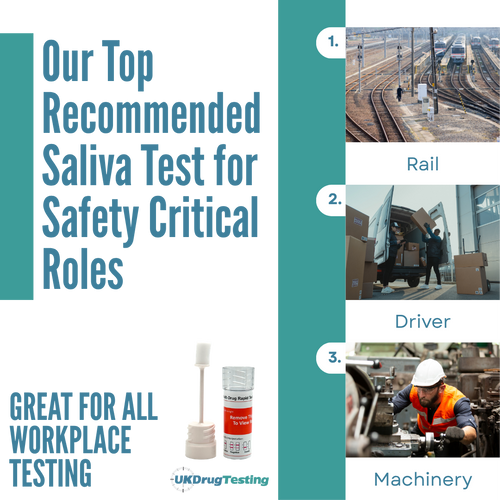
For many roles that is mainly a wellbeing issue. For safety-critical roles such as driving, operating plant or forklifts, working at height or working near the railway, it is a genuine risk to life. Under the Health and Safety at Work etc. Act 1974, every employer has a legal duty to protect the health, safety and welfare of their staff, and drug and alcohol misuse falls squarely within that duty.
I have also noticed ketamine coming up far more often than it used to, particularly among younger adults. It causes both mental and physical impairment, which is why I now include it on almost every workplace panel I recommend.
Before you buy: put your drug and alcohol policy in place first
Clinically speaking, the test itself is the easy part. What protects you, and your staff, is the policy that sits behind it. Before you order a single kit, make sure you have the following in place.
- A written drug and alcohol policy. It should explain who may be tested, when and how testing happens, what happens after a non-negative result and what support is available. Consult your staff when you draw it up and make sure everyone has read it.
- Consent. You cannot drug test anyone without their consent. What you can do is make testing a condition of employment in your contracts and policy, so that an unreasonable refusal can be treated as a disciplinary matter.
- A proportionate reason to test. The Health and Safety Executive (HSE) is clear that testing should be proportionate, justified by risk and clearly communicated. It is easiest to justify for safety-critical roles.
- Careful data handling. Drug test results are health information, which counts as special category data under UK GDPR. Store results securely, share them only with people who need to know, and do not keep them longer than necessary. The Information Commissioner's Office publishes guidance for employers on this.
- Sector rules. Some industries have their own legal requirements on top of your policy. The Transport and Works Act 1992, for example, makes it an offence for certain rail and tram workers to work while unfit through drink or drugs.
Your policy should also set out which types of testing you use. Most employers choose from pre-employment testing, random testing, for-cause testing where there is reasonable suspicion of impairment, post-incident testing after an accident or near miss, and follow-up testing for someone returning to work after treatment.
Doctor's tip: The workplaces that get the most from testing are the ones that pair it with genuine support. When staff know the process is fair and confidential, and that asking for help early will be treated differently from a failed test, they are far more likely to come forward before something goes wrong.
Urine or saliva: which sample should you test?
This is the first real decision, and there is no single right answer. Each sample type looks at a different window of time and suits a different kind of testing.
Saliva (oral fluid) drug tests
Saliva tests pick up recent drug use, generally within the previous few hours to a day or two. That makes them the closest thing to a measure of current impairment you will get from a rapid test. Collection is done face to face, so it is very hard to cheat, no toilet is needed, and many kits include an alcohol screen as well. This makes saliva the natural choice for random, for-cause and post-incident testing, especially out on site.
Urine drug tests
Urine tests look further back, usually over several days and up to a month in heavy cannabis users. Urine cups can screen for more drugs at once and are very cost effective, which is why they are so popular for pre-employment checks. The drawback is that the sample is given in private, so there is more opportunity for tampering. If you choose urine, always pick a cup with a built-in temperature strip, and ideally adulteration pads too.
| Feature | Saliva test | Urine test |
|---|---|---|
| What it tells you | Recent use, from hours up to around 2 days | Use over recent days, or weeks for heavy cannabis use |
| Best suited to | Random, for-cause and post-incident testing | Pre-employment and routine screening |
| Collection | Observed, face to face | Private, in a toilet |
| Tampering risk | Very low | Higher, so choose a cup with temperature and adulteration checks |
| Alcohol screen | Included on several of our kits | Not included |
| Time to result | 5 to 10 minutes | 5 to 10 minutes |
How many drugs should you test for?
You will see drug tests described by the number of "panels" they have. Each panel is a separate test strip for one drug or drug group, so a 7 panel kit gives you seven individual results from a single sample.
More panels is not automatically better. The aim is to match the test to the drugs actually being used in the UK and to the risks in your workplace. As a sensible starting point, I would want any workplace panel to cover:
- Cannabis, still by far the most commonly used drug in the UK
- Cocaine
- Opiates, such as heroin, morphine and codeine
- Amphetamines and methamphetamine
- Ecstasy (MDMA)
- Ketamine
- Benzodiazepines
Broader panels add drugs such as methadone, buprenorphine, tramadol, barbiturates and tricyclic antidepressants. These are worth considering in healthcare, occupational health and addiction support settings, or wherever misuse of prescription medicines is a concern.
A quick word on cut-off levels
Every panel has a cut-off level, measured in nanograms per millilitre (ng/ml). A sample containing less than the cut-off will read as negative. Workplace tests use established cut-offs designed to catch genuine use while making it very unlikely that trace exposure, such as standing near someone smoking cannabis, triggers a result. Our standard ALLTEST workplace urine cups screen cannabis at 50 ng/ml, for example.
Ultra-sensitive cups use lower cut-offs. Our UKDrugTesting 13 panel cup screens cannabis at 20 ng/ml, which suits close monitoring but is more likely to pick up very low levels. Neither is wrong, but you should always know which one you are using and say so in your policy.
Which drug test should I buy? My recommendations
We stock a focused range of professional ALLTEST and UKDrugTesting kits, all CE marked and made to professional standards. These are the ones I recommend most often to employers.
Best all-round workplace test: 11 Panel Saliva Drug and Alcohol Test (ALLTEST 8117)
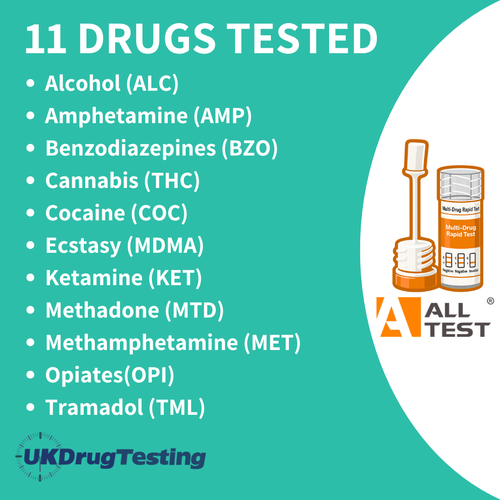
If I could only recommend one kit, this would be it. The ALLTEST 8117 11 panel saliva test screens for 10 drugs plus alcohol, including ketamine, with results in 10 minutes. It is our top choice for drivers, machine operators, construction and railside workers, and anyone else in a safety-critical role.
It comes in packs of 1, 5, 20 and 100, and the 100 test packs qualify for a free one-hour drug testing training session with our specialists, which is well worth taking up if you are setting up a testing programme for the first time.
Best value saliva tests: ALLTEST DSD877 and 863A/MTD
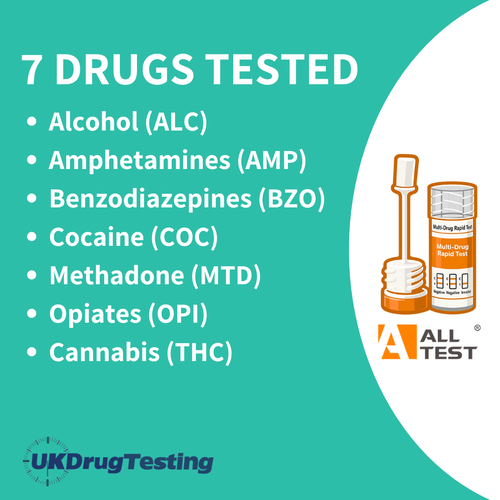
For regular random testing on a tighter budget, the ALLTEST DSD877 7 panel saliva kit screens for six common drugs plus alcohol, and doubles as its own collection device.
The ALLTEST 863A/MTD is a similar 7 panel drug and alcohol kit, built around the drug combination used in UK roadside screening. It reads at 5 minutes and uses less packaging than many saliva kits, which is a nice bonus if you test in volume.
Widest saliva screen: ALLTEST DSD-8135
If you want the recent-use window of saliva with the broadest possible coverage, the DSD-8135 13 panel saliva drug and alcohol kit is our most comprehensive oral fluid test.
Best for pre-employment checks: 13 Drug Urine Cup (ALLTEST)
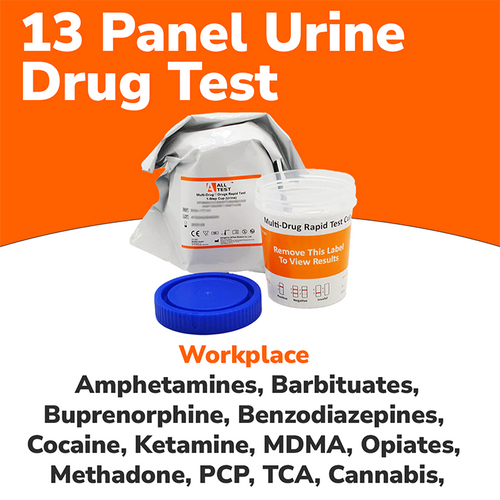
For pre-employment screening, I like the ALLTEST 13 panel urine cup. It tests for 13 drugs at standard workplace cut-offs and, importantly, includes a three-pad adulteration strip checking oxidants, pH and specific gravity, plus a temperature strip. Together these tell you whether a sample is fresh and has not been diluted or tampered with. The screw lid seals the cup securely, which keeps the whole process clean and simple.
Standard workplace urine cup: ALLTEST 10 Panel (1107-B1-Tram-Ket)
The ALLTEST 10 panel cup is one of our best-selling workplace tests. It screens for 10 drugs at standard workplace sensitivities, including ketamine and tramadol, with clear results within 10 minutes.
Broadest urine screens: 18 and 23 panel cups
For occupational health, healthcare and addiction support services, or wherever prescription drug misuse is a worry, the ALLTEST 18 panel cup (with a built-in temperature strip) and the UKDrugTesting 23 panel cup cover the widest range of substances we offer.
Quick guide: which test for which situation?
| Your situation | What I recommend |
|---|---|
| Random testing of drivers or machine operators | 11 Panel Saliva (ALLTEST 8117) |
| Post-incident or for-cause testing | 11 Panel Saliva (ALLTEST 8117) or 7 Panel Saliva (863A/MTD) |
| Pre-employment screening | 13 Drug Urine Cup (ALLTEST) |
| High-volume routine testing on a budget | 7 Panel Saliva (DSD877) or 10 Panel Urine Cup |
| Healthcare, occupational health or prescription drug concerns | 18 Panel or 23 Panel Urine Cup |
| Follow-up testing after treatment | 13 Drug Ultra-Sensitive Urine Cup (UKDrugTesting) |
How to carry out a saliva drug test step by step
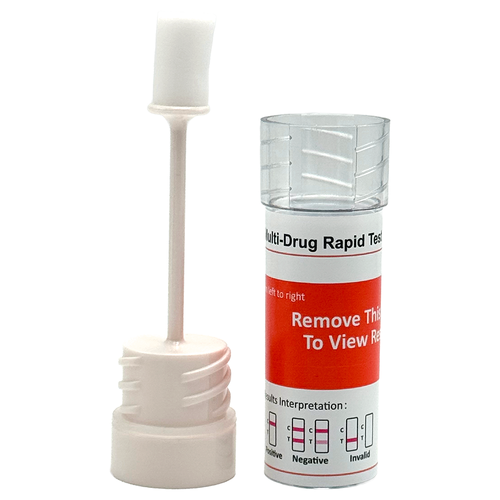
Before you start, choose a quiet, private space. Explain the process, check the person's identity and ask them to sign a consent form that lists any medicines they have taken recently. Then follow these steps.
- Check the kit. Make sure it is in date and the foil pouch is sealed and undamaged. Only open it when you are ready to test.
- Wait 10 minutes. The donor should not eat, drink, smoke or chew gum for at least 10 minutes before the test. Keep them with you during this time.
- Collect the sample. Sweep the swab thoroughly around the inside of the mouth, between the teeth and gums on the top and bottom jaws, and over the tongue. Then ask the donor to hold the swab in their mouth until the sponge is completely soaked with saliva.
- Close the device. Insert the swab and close the lid fully. If the sponge is not wet enough, the lid may not seal properly and the test will not run.
- Watch the results window. Stand the test on a flat surface and watch for the control lines to appear.
- Read at the right time. Read the result at the time given in the instructions, which is 5 minutes for the 863A/MTD and 10 minutes for the 8117. Never read it after the maximum time stated.
- Record everything. Note the kit's lot number and expiry date, the time of the test and the result for each panel, then both sign the record.
Getting cannabis right in saliva: Cannabis is harder to pick up in saliva than in urine. Saliva kits detect THC residue in the mouth, so a quick wipe will not do. The swab needs to go all the way around the mouth, and the chance of detection is highest saround 20 minutes after use.
How to carry out a urine drug test step by step
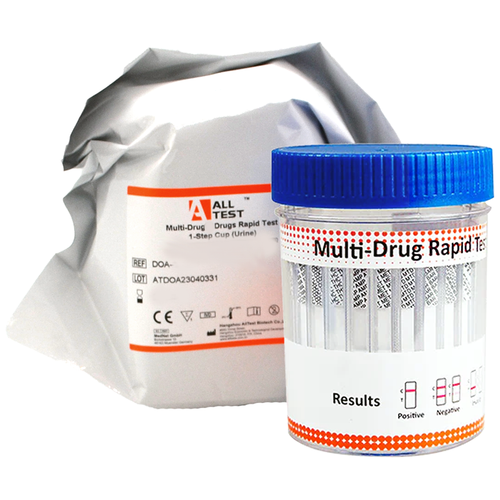
Urine testing needs a little more preparation, because the sample is given behind a closed door. The same consent and identity checks apply.
- Prepare the toilet. If you can, add a blue colouring agent to the toilet bowl and cistern and turn off or tape over the taps, so the sample cannot be watered down.
- Prepare the donor. Ask them to leave coats, bags and bulky outer clothing outside, and to wash their hands.
- Check and label the cup. Check the expiry date, open the pouch and write the donor's details on the cup before handing it over.
- Collect the sample. The donor should fill the cup to at least the minimum fill line, close the lid tightly and hand it straight back to you.
- Check the temperature within 4 minutes. A fresh sample should read between 32 and 38°C. A reading outside this range suggests the sample may not be fresh or genuine.
- Read the adulteration pads. If your cup has them, compare the pads against the colour chart supplied.
- Read the drug results. Place the cup on a flat surface and read the results at the time stated in the instructions, usually 5 minutes. Some cups start testing as soon as the urine reaches the strips, while others need tilting once the lid is closed, so check the leaflet for your kit. Never interpret results after the maximum time given.
- Record and seal. Record every result, sign the paperwork together and keep any non-negative sample sealed and labelled.
How to read the result correctly
This is where I see the most mistakes, and it is completely understandable. If you have ever used a pregnancy test, you will know that a line in the test window means a positive result. Drug tests work the other way round.
- Negative: a line appears in the control region (C) and a line appears in the test region (T) for that drug. Any line in the T region, however faint, counts as negative.
- Non-negative: a line appears at C but there is no line at T for that drug. This means the drug may be present above the cut-off level.
- Invalid: no line appears at C. The test has not worked, often because there was too little sample. Throw it away and retest with a new kit.
Remember: A faint line on a drug test means negative. That is the exact opposite of a faint line on a pregnancy test, so it is worth pointing out to anyone who is new to carrying out tests.
You will notice I say "non-negative" rather than "positive". That is deliberate. A rapid test is a screening test, and a result only becomes a confirmed positive once it has been checked by an accredited laboratory.
What to do if a test is non-negative
Stay calm, keep the conversation private and avoid any accusations. A non-negative screen is a reason to look more closely, not a verdict.
- Ask about medicines. Several everyday medicines can cause a non-negative screen. Co-codamol and other codeine painkillers can show up as opiates, prescribed diazepam as a benzodiazepine, some ADHD medicines as amphetamines and certain older antidepressants as tricyclics. Even poppy seeds can occasionally trigger an opiate result.
- Send a sample for laboratory confirmation. Laboratory testing using GC-MS or LC-MS identifies exactly which substance is present and at what level. Never take disciplinary action on a rapid screening result alone. I always suggest keeping at least one laboratory confirmation pack from our sister site UK Drug Testing alongside your kits, so you can move straight to confirmation.
- Follow your policy on interim steps. For safety-critical roles, most policies temporarily move the person away from those duties while the laboratory result is awaited.
- Keep it confidential. Only those who genuinely need to know should be told.
How far back does each test look?
One of the most common questions I am asked is how long drugs stay detectable. Here is a general guide.
| Drug | Saliva | Urine |
|---|---|---|
| Cannabis | Up to around 24 hours | 3 to 5 days with occasional use, up to 30 days with heavy use |
| Cocaine | 1 to 2 days | 2 to 4 days |
| Amphetamines | 1 to 3 days | 1 to 3 days |
| Opiates | 1 to 2 days | 2 to 3 days |
| Ketamine | 1 to 2 days | 2 to 4 days |
| Benzodiazepines | 1 to 3 days | 3 to 7 days, longer with regular use |
| Alcohol | Up to around 12 hours | Not tested on our urine cups |
These are estimates only. Detection times vary with the amount taken, how often the person uses the drug, their metabolism and hydration, and the sensitivity of the kit being used.
Common mistakes I see employers make
- Testing before a policy is in place, or singling out one person without the clear, fair reason your policy sets out.
- Acting on a screening result without laboratory confirmation.
- Reading results too late. Lines can appear or change after the maximum reading time, so always use a timer.
- Storing kits in a van, cab or site cabin where the temperature swings. Keep them somewhere cool and dry, out of direct sunlight.
- Using kits past their expiry date, which can give unreliable results.
- Rushing saliva collection so the swab is not properly soaked.
- Forgetting to record prescribed and over-the-counter medicines before the test.
- Choosing an ultra-sensitive test for routine employment screening without realising its cut-offs are lower.
Supporting your staff, not just testing them
Drug and alcohol dependence are recognised medical conditions, and the HSE encourages employers to prioritise support and early intervention alongside any formal process. In my experience, the best outcomes come when someone feels able to ask for help before a test forces the issue.
Make sure your team knows where to turn. That might be your occupational health provider or employee assistance programme, their own GP, or FRANK, the free and confidential national drugs advice service, which can also be reached on 0300 123 6600.
Frequently asked questions
Can I drug test an employee without their consent?
No. Testing always needs the person's consent. However, if drug testing is written into your contracts and policy, an unreasonable refusal can be handled as a disciplinary matter. Take HR or legal advice if you are unsure.
Can I make a drug test part of my recruitment process?
Yes. Many employers make job offers conditional on a negative pre-employment drug test. Tell candidates about it at the start and apply it consistently to everyone applying for that role.
How accurate are rapid workplace drug tests?
Very accurate when used correctly. The ALLTEST kits we supply report accuracy of around 97 to 99% for individual drug panels when compared with laboratory GC-MS testing. They are still screening tests, so any non-negative result should always be confirmed by a laboratory.
Could CBD products cause a positive cannabis result?
Pure CBD should not, because workplace tests look for THC rather than CBD. However, many CBD products contain traces of THC, and regular use could lead to a non-negative result. It is worth addressing CBD in your policy so there are no surprises.
Can a saliva test detect alcohol?
Yes. Our 8117, DSD877, 863A/MTD and DSD-8135 saliva kits all include an alcohol screen alongside the drug panels.
Do you offer bulk pricing for employers?
Yes. Most of our drug tests are available in multi-packs, and we are happy to help with larger orders. Please contact our UK-based team or visit our FAQ page for more information.
Need more choice? Visit our specialist site, UK Drug Testing
The kits above are the ones I recommend most often, but they are only a small part of what we offer. Our sister site, UK Drug Testing, is our dedicated drug and alcohol testing shop, and it carries a much wider range for employers of every size.
Over there you will find:
- Dual chamber split cup urine kits, plus saliva tests from 4 up to 13 panels.
- Breathalysers, from single-use disposables to digital devices.
- Workplace drug and alcohol starter bundles for employers setting up testing for the first time.
-
Laboratory confirmation packs for both urine and saliva.
- Online drug test training for managers and supervisors.
If you are still not sure which kit suits your workplace, the quickest way to find out is the UK Drug Testing workplace quiz. Answer a few quick questions and it will point you towards the tests best suited to your needs. If you would rather talk it through with a person, their UK-based team is available Monday to Friday, 8.30am to 5pm, on 01263 731 168.
Medical and Legal Disclaimer
The information in this article is for general educational purposes only and does not replace professional medical, legal or HR advice. Workplace drug testing must be carried out in line with a clear written policy, with the informed consent of the person being tested and in accordance with UK employment and data protection law.
Rapid drug tests are screening tests. Any non-negative result should be confirmed by an accredited laboratory before any action is taken. Detection times given in this article are estimates and vary between individuals.
If you are worried about your own drug or alcohol use, or that of someone close to you, please speak to your GP or contact FRANK for free, confidential advice.