

Drug Screening Test Guide: Kits, Machines and Where to Buy
Author Dr Kate Garside
Drug Screening Tests: How They Work, Which Kit to Choose and Where to Buy One in the UK
Every week our team speaks to people who have decided they need a drug test, then run straight into a wall of choice. Urine or saliva? Seven drugs or thirteen? Do you need a machine? And where do you buy one you can actually trust?
Here is the short answer. A drug screening test is a rapid test that checks a urine or saliva sample for common drugs and gives a result in around 5 to 10 minutes. It tells you whether a drug may be present above a set level. It does not prove it, which is why any unexpected result should always be confirmed by a laboratory.
In this guide I will explain how a drug screen test kit works, the differences between urine, saliva and combined drug and alcohol kits, whether a drug test machine is worth the money, and where to buy a reliable test in the UK.
What is a drug screening test?
Whether you call it a drug screen, a drugs screen test or a tox screen, the principle is the same. Each test strip inside the kit carries antibodies designed to recognise one drug or drug group. When you add the sample, it travels along the strip. If there is little or none of that drug present, a coloured line forms in the test region. If the drug is present above the cut-off level, it blocks that line from forming.
Because the test is looking for a level rather than proving identity, rapid tests are described as screening tests. You will see professionals talk about a non-negative result rather than a positive one, because only a laboratory can say for certain which substance is present and how much.
I often describe a drug screen as a smoke alarm. It is quick, inexpensive and very good at telling you that something needs a closer look. It is not the fire investigator. That job belongs to the laboratory, which uses techniques such as LC-MS/MS or GC-MS to identify the exact drug and measure it.
Why drug screening is so widely used in the UK
Drug use is more common than many people realise. The Office for National Statistics estimates that around 2.9 million adults aged 16 to 59 in England and Wales used an illegal drug in the year to March 2025, and around 680,000 were frequent users. Cannabis remains the most commonly used drug, followed by powder cocaine.
That is why drug screening now turns up in so many settings:
- Employers screening staff in safety-critical roles such as driving, construction and operating machinery.
- Recovery and treatment services supporting people to stay drug free.
- Clinics and occupational health teams carrying out health assessments.
- Individuals and families who want private reassurance, for example as part of an agreed recovery plan.
Whatever the setting, one principle never changes. A drug test should only ever be carried out with the person's informed consent. Testing someone covertly damages trust and, at work, can leave an employer on the wrong side of employment and data protection law.
Types of drug screen test kit
There are several formats, and each one looks at a different window of time. Choosing the right one starts with the question you are trying to answer.
Urine drug screening cups, dip cards and strips
Urine is the most widely used sample. An all-in-one cup collects and tests the sample in one step, which keeps things clean and simple. Dip cards and single strips are cheaper but need a separate collection pot. Urine shows drug use over the previous few days, and longer for regular cannabis users.
Saliva (oral fluid) drug tests
A saliva swab picks up recent use, generally within hours up to a day or two. Collection is done face to face, so it is very hard to tamper with, and no toilet is needed.
Drug and alcohol test kits
Several saliva kits include an alcohol pad alongside the drug panels, so one swab screens for both. For alcohol on its own, a breathalyser is the standard choice.
Drink spiking tests
These test a drink rather than a person. Our drink spiking test kit checks a drink for ketamine and GHB before you take a sip.
| Test type | What it tells you | Typical detection window | Result in | Best for |
|---|---|---|---|---|
| Urine cup or dip card | Drug use over recent days | Most drugs 1 to 4 days, longer with regular cannabis use | 5 to 10 minutes | Pre-employment, routine and home screening |
| Saliva swab | Recent use, the closest a rapid test gets to current impairment | Hours, up to around 2 days | 5 to 10 minutes | Random, for-cause and post-incident testing |
| Breathalyser | Alcohol in the body right now | While alcohol is still being cleared | Seconds | Alcohol checks at work |
| Laboratory test | The exact drug and how much is present | Depends on the sample, hair can show up to around 90 days | Usually a few days | Confirming a non-negative screen |
Detection times are estimates and vary with the amount taken, how often someone uses, their metabolism and the sensitivity of the kit. The UK Drug Testing guide to detection times and levels goes into each drug in more detail.
The urine drug screening test explained
For most people, a urine drug screening test is the natural starting point. It screens for more drugs in one go than any other rapid format, it is very cost effective, and the results are simple to read.
The weak point of urine is that the sample is given in private. That is why the better cups include built-in tamper checks:
- A temperature strip. A fresh sample should read between 32 and 38°C within about 4 minutes of collection.
- Adulteration pads. These check oxidants, pH and specific gravity, so a sample that has been diluted or interfered with stands out.
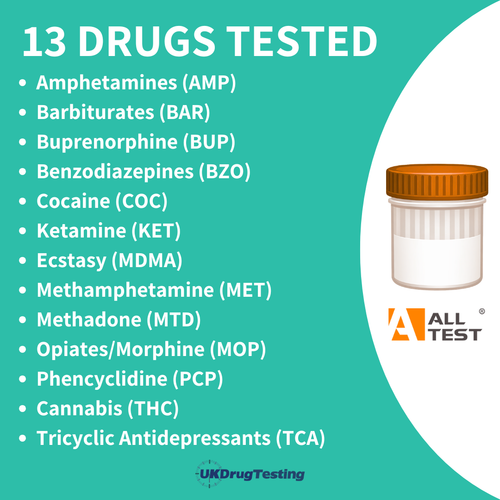
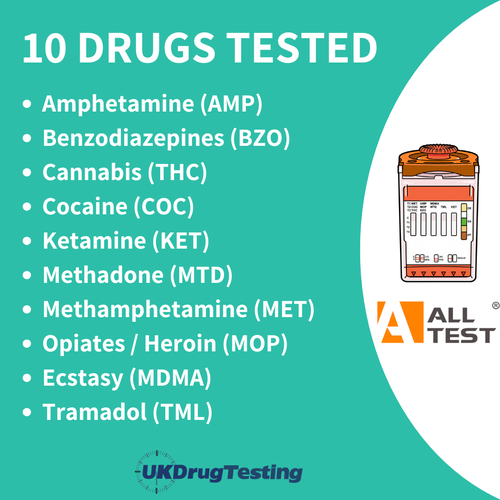
Our ALLTEST 13 drug urine cup has both, plus a secure screw lid, and screens for 13 drugs including cannabis, cocaine, ketamine and benzodiazepines. The ALLTEST 10 drug urine cup is a popular lower cost choice that still covers ketamine and tramadol. For the broadest screens, the 18 drug and 23 drug cups cover the widest range of substances we stock.
What cut-off levels mean
Every panel has a cut-off, measured in nanograms per millilitre (ng/ml). Below it, the result reads negative. Cut-offs are set so that genuine use is detected while trace exposure, such as standing near someone smoking cannabis, is very unlikely to trigger a result. Saliva tests use much lower cut-offs than urine, simply because drugs are present in saliva at lower concentrations.
| Drug | Urine cut-off (ALLTEST 13 drug cup) | Saliva cut-off (ALLTEST DSD877) |
|---|---|---|
| Cannabis | 50 ng/ml | 12 ng/ml |
| Cocaine | 300 ng/ml | 20 ng/ml |
| Opiates | 300 ng/ml | 40 ng/ml |
| Amphetamine | 1000 ng/ml | 50 ng/ml |
| Methadone | 300 ng/ml | 30 ng/ml |
| Benzodiazepines | 300 ng/ml | 50 ng/ml |
Ultra-sensitive kits use lower cut-offs again. Our UKDrugTesting 13 drug urine cup, for example, screens cannabis at 20 ng/ml, which suits close monitoring during recovery but is more likely to pick up very low levels.
Choosing a drug and alcohol test kit
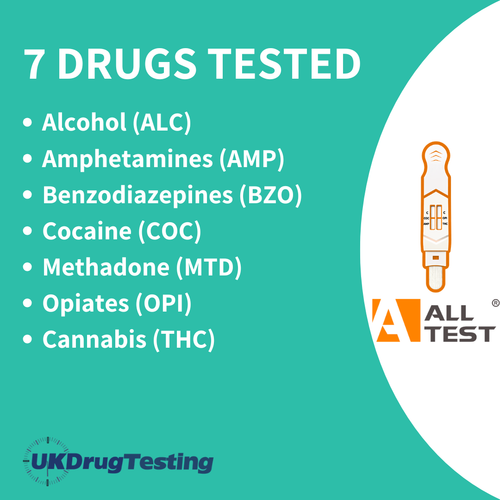
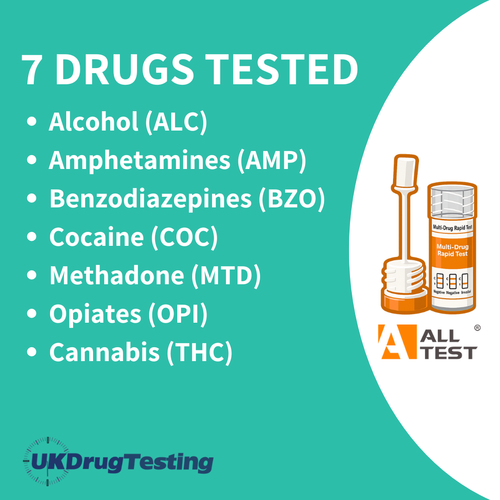
If alcohol matters to you as much as drugs, a urine cup on its own will not do the job, because our urine cups do not screen for alcohol. A saliva drug and alcohol test kit covers both from a single swab. These are the kits I recommend most often:
- ALLTEST 863A/MTD: six drugs plus alcohol, read at 5 minutes, and built around the drug combination used in UK roadside screening.
- ALLTEST DSD877: six drugs plus alcohol, with the device doubling as its own collection container.
- ALLTEST 8117: ten drugs plus alcohol, including ketamine, and our top pick for drivers and machine operators.
- ALLTEST DSD-8135: our widest saliva screen, with 13 panels including alcohol.
If you need to know whether someone has been drinking over the last few days rather than right now, EtG urine strips detect a breakdown product of alcohol for up to around 80 hours, depending on how much was drunk.
Important: a test kit cannot tell you if you are safe to drive
Never use a home drug or alcohol test to decide whether you can drive. Drugs and alcohol can affect your judgement and reactions even below the level a rapid test detects.
In the UK it is an offence to drive with certain drugs in your blood above set limits, or while unfit to drive through drink or drugs, including some prescribed medicines. The GOV.UK drug driving guidance explains the law. If you have taken drugs or had a drink, do not drive.
How many drugs should a drug screen test for?
Drug tests are described by their number of panels. Each panel is a separate strip for one drug or drug group, so a 7 panel kit gives you seven separate results from one sample. More is not automatically better. The aim is to match the test to the drugs that matter in your situation.
- 5 to 7 panels cover the core drugs: cannabis, cocaine, opiates, amphetamines and usually benzodiazepines or methadone.
- 10 to 13 panels add drugs such as ketamine, ecstasy (MDMA), methamphetamine and buprenorphine. This is the sensible standard for most workplaces.
- 18 to 23 panels add a wider range of prescription and synthetic drugs, which is useful in healthcare, occupational health and addiction services.
Ketamine is coming up far more often than it used to, particularly among younger adults, so I would now want it on almost any multi-drug panel. If you are choosing tests for a business, our guide to drug testing at work covers panel choice, policies and consent in much more depth.
Do you need a drug test machine?
This is one of the questions I am asked most, and for the vast majority of people the answer is no. A standard rapid test is read by eye and needs no equipment at all. That said, there are a few types of drug test machine, and it helps to know what each one does.
- Digital cassette readers. Some occupational health services and police forces use a small electronic reader that scans a saliva or urine test cassette and records the result. UK police use approved roadside devices that screen a mouth swab for cannabis and cocaine, with a blood test at the station to confirm.
- Fingerprint readers. These analyse sweat from a fingertip and pick up recent use, typically within the last day or two. You can read more about the pros and cons in this guide to fingerprint drug tests.
- Laboratory analysers. These are the large instruments that confirm a result, identifying exactly which drug is present and in what amount. You access them by sending a sample, not by buying one. Laboratory confirmation packs make this straightforward.
- Breathalysers. For alcohol, a digital breathalyser is the one machine many workplaces do buy. Digital breathalysers suit regular screening, and an evidential breathalyser is designed for results that may be relied on in a formal process.
A reader removes the guesswork of judging lines by eye, but it does not make the chemistry any more accurate. The test strip inside is still doing the work. For most homes and small businesses, a good quality visual test backed by laboratory confirmation is far better value than a machine costing hundreds or thousands of pounds.
Doctor's tip: If reading lines by eye worries you, set a timer, read the test in good natural light at exactly the time stated in the instructions, and take a photograph at that moment. In a workplace, ask a second trained person to check the reading with you.
Where can I purchase a drug test in the UK?
You have more choice than you might expect, but not all of it is equal. Here is how the main options compare.
| Where to buy | Good for | Worth knowing |
|---|---|---|
| Specialist online suppliers | The widest choice, published cut-offs, bulk pricing, laboratory confirmation and expert advice | Check the seller is a genuine UK business with real customer support |
| Pharmacies and supermarkets | Picking up a single kit in person | Ranges are small, usually a basic urine test without tamper checks, and some large chains do not stock drug tests at all |
| Online marketplaces | Convenience | Quality varies widely, so check the drug list, cut-offs, expiry date and CE or UKCA marking |
| Occupational health providers and test centres | Having a trained collector carry out the test for you | Higher cost per test and you will usually need to book |
| Accredited laboratories and court-approved services | Results needed for legal, family court or disciplinary purposes | Not instant, and a documented chain of custody is required |
Your checklist before you buy
- Proper marking: the kit should be CE or UKCA marked as a diagnostic device.
- A full drug list with cut-offs: if a seller cannot tell you the cut-off for each panel, look elsewhere.
- The right sample type: urine for a longer look back, saliva for recent use.
- Tamper checks: for urine, look for a temperature strip and adulteration pads.
- Foil sealing and a long expiry date: moisture and age both make results less reliable.
- Clear instructions in English and a reading time printed on the pack.
- A route to laboratory confirmation for any non-negative result.
- UK-based support from someone who will answer the phone if you have a question.
Buying a drug test from Access Diagnostics
Every drug screening test we stock is CE marked and made to professional standards by ALLTEST and UKDrugTesting, the same kits used by UK employers, clinics and recovery services. Orders placed before 3pm on a weekday are dispatched the same day in discreet packaging, and our price match guarantee means you will not overpay.
Our sister site, UK Drug Testing, is run by the same doctor-led team and carries an even wider range, including split cup urine kits, home drug testing kits and breathalysers.
How to get a result you can trust
Even the best drug screen test kit will give a poor result if it is used badly. These are the steps that make the biggest difference:
- Check the expiry date and only open the foil pouch when you are ready to test.
- Store kits somewhere cool and dry, never in a car, van or steamy bathroom.
- For saliva tests, make sure nothing has been eaten, drunk or smoked for at least 10 minutes beforehand, and sweep the swab right around the mouth.
- For urine tests, fill the cup to at least the minimum line and check the temperature strip within 4 minutes.
- Read the result at the stated time and never after the maximum time in the instructions.
- Record everything, including the kit's lot number, the time and the result for each panel.
Reading the result is where most mistakes happen. On a drug test, any line in the test region, however faint, means negative. No line means non-negative, and no control line means the test is invalid. That is the exact opposite of a pregnancy test, which catches many people out. UK Drug Testing has a clear guide on how to read drug test results, and our workplace testing guide walks through each step.
Doctor's tip: Always ask about medicines before the test, not after. Codeine painkillers can show as opiates, prescribed diazepam as a benzodiazepine, some ADHD medicines as amphetamines and certain older antidepressants as tricyclics. Even poppy seeds can occasionally trigger an opiate result. Writing these down first makes any later conversation far easier.
Common drug screening myths
| The myth | The facts |
|---|---|
| "A faint line means the test is positive." | On a drug test, any line in the test region means negative, however faint it is. |
| "Drinking lots of water will hide drug use." | A heavily diluted sample shows up on the specific gravity pad, and is treated as a reason to retest rather than a pass. |
| "Standing near someone smoking cannabis will make you fail." | Cut-offs are set so that passive exposure is very unlikely to give a non-negative result. |
| "CBD oil cannot show up on a drug test." | Pure CBD should not, but many CBD products contain traces of THC, and regular use can lead to a non-negative cannabis result. |
| "A home test is as good as a laboratory test." | A rapid test is a screen. Only a laboratory can confirm which drug is present and how much. |
| "More panels always means a better test." | Extra panels add cost and more chances of a medicine causing a non-negative result. Choose the drugs that matter to you. |
What to do if a drug screen is non-negative
Take a breath. A non-negative screen is a reason to look more closely, not a verdict.
- Check for medicines that could explain the result, including anything bought over the counter. The UK Drug Testing page on false positive drug screens lists the common culprits.
- Send a sample for laboratory confirmation before anyone acts on the result. Confirmation by a UKAS accredited laboratory identifies the exact substance.
- Keep the sample sealed and labelled until you know whether it needs to go to the laboratory.
- At work, follow your written policy and keep the matter confidential.
- At home, lead with support rather than blame. A calm conversation achieves far more than a confrontation.
Speak to your GP or contact FRANK if:
- you are worried about your own drug or alcohol use, or someone else's
- you want help to cut down or stop
- you notice withdrawal symptoms such as shaking, sweating or severe anxiety when not using
FRANK offers free, confidential advice on 0300 123 6600.
Call 999 if someone has taken drugs or alcohol and they:
- cannot be woken or are not responding normally
- are breathing very slowly, noisily or not at all
- have a seizure
- have chest pain
- are very hot, confused or agitated
Red flag: Never leave someone who is very drowsy after taking drugs or alcohol to sleep it off alone. Put them in the recovery position, stay with them and call 999.
Frequently asked questions
What is the difference between a drug screen and a drug test?
People use the terms interchangeably. Strictly speaking, a drug screen is the rapid first-stage test that shows whether a drug may be present, while a confirmatory laboratory test identifies the exact substance and level. Most drug test kits you can buy are screening tests.
How accurate is a drug screening test?
Very accurate when used correctly. The ALLTEST kits we supply report accuracy of around 97 to 99% for individual panels compared with laboratory GC-MS testing. Because they are screening tests, any non-negative result should still be confirmed by a laboratory before decisions are made.
How much does a drug test cost in the UK?
On our site, most multi-drug urine cups and saliva kits cost between about £7.50 and £14 per test, with lower prices per test on multi-packs. Laboratory confirmation and test centre services cost more because of the analysis and paperwork involved.
Can I buy a drug test kit for home use?
Yes. Our urine and saliva kits come with full instructions and are simple to use at home. For family situations, I always suggest agreeing the testing together beforehand, so it supports trust rather than undermining it.
Does a urine drug screening test detect alcohol?
Our standard urine drug cups do not. For alcohol, use a saliva drug and alcohol test kit, a breathalyser, or EtG urine strips if you need to look back over the last few days.
How quickly will I get a result?
Most rapid tests give a result in 5 to 10 minutes. Breathalysers take seconds, while laboratory confirmation usually takes a few working days.
Can I drug test someone without their consent?
No. Testing should always be done with the person's informed consent. Employers can make testing a condition of employment through contracts and a clear written policy, but the person must still agree at the time of the test.
Drug screening with Access Diagnostics
Access Diagnostics has supplied trusted diagnostic tests to UK households, employers, clinics and the NHS since 2001, and we are still founded and run by doctors. Whether you need a single home drug test or a bulk order for your workplace, our UK team is on hand by phone, email and live chat from 8.30am to 5pm, Monday to Friday. If you are unsure which kit to choose, get in touch and we will point you in the right direction.
The right drug screening test, used carefully and backed by laboratory confirmation when it matters, gives you a quick and reliable answer. The wrong one, or a good one used badly, just gives you more questions.
Medical disclaimer
The information in this article is for general educational purposes only and does not replace professional medical, legal or HR advice. Drug and alcohol testing should always be carried out with the informed consent of the person being tested and, at work, in line with a clear written policy and UK employment and data protection law.
Rapid drug and alcohol tests are screening tests. Any non-negative result should be confirmed by an accredited laboratory before any action is taken. Detection times and cut-off levels given here are estimates or manufacturer figures and vary between individuals and products. Never use a home test to decide whether you are safe or legally permitted to drive.
If you are worried about your own drug or alcohol use, or that of someone close to you, speak to your GP or contact FRANK on 0300 123 6600. In an emergency, call 999. Access Diagnostics provides test kits to support awareness and responsible decisions. They are not a substitute for professional medical advice or laboratory diagnosis.